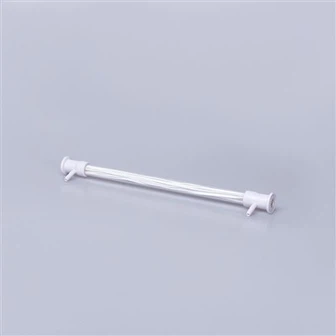

Next-Generation Biopurification Technology: Fundamental Theory, Key Attributes, And Industrial Applications Of Membrane Chromatography
I. What Is Membrane Chromatography?
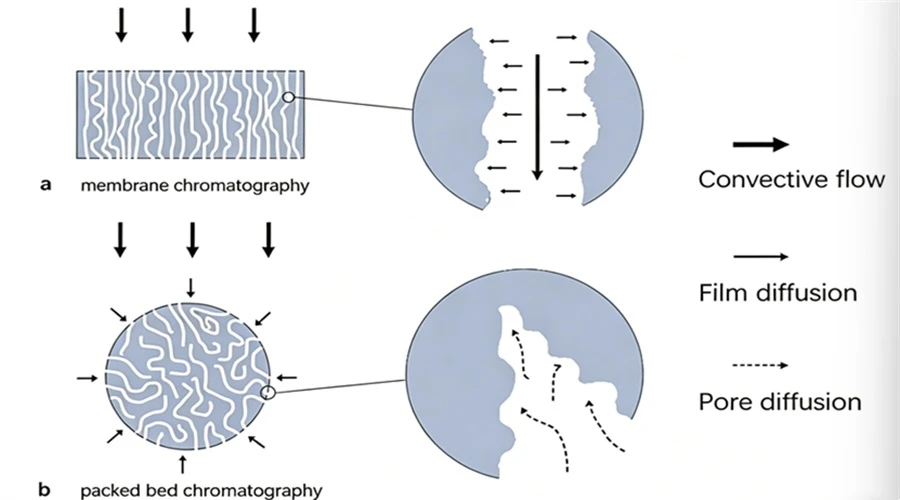
Membrane chromatography uses porous separation membranes as the chromatographic medium, with specific ligands immobilized on the membrane surface. By relying on convection-dominated mass transfer rather than the diffusion-limited mass transfer of traditional resin-based chromatography, it enables high flow rates, high resolution, easy scalability, low pressure drop, and single-use bioprocessing for the purification of biomolecules.
Key Conclusion: Membrane chromatography is a highly efficient purification technology based on convection-dominated mass transfer.

II. Differences Between Membrane Chromatography and Resin-Based Packed-Bed Chromatography
Fundamental Difference in Mass Transfer
- Resin-based packed-bed chromatography: The pores within resin particles are dead-end pores, resulting in extremely slow diffusion of large molecules. As the flow rate increases, both resolution and binding capacity decrease sharply.
- Membrane chromatography: The membrane pores are predominantly through-pores, allowing solutes to be transported directly by convection to the binding sites on the pore walls. Therefore, the flow rate has little effect on resolution and binding capacity.

III. Innovations in Membrane Chromatography: Three-Dimensional Breakthroughs in Materials, Modules, and Processes
1. Innovations in Membrane Materials (Matrix + Ligand + Coupling)
Matrix:
- Natural: cellulose, polysaccharides.
- Synthetic: nylon, PES, PTFE.
- Novel: nanofibers, agarose fibers (high specific surface area).
Ligands:
- Ion exchange (most mature): quaternary ammonium groups (AEX), sulfonic acid groups (CEX).
- Affinity: Protein A/G, peptide ligands, metal chelation (IDA), dyes, aptamers.
- Hydrophobic: phenyl, alkyl groups.
Coupling Technologies: For membrane matrices with reactive sites on the membrane surface:
Pre-synthesized ligands can be directly coupled to the membrane surface.
Polymerization can be initiated directly on the membrane surface. For example, cation-exchange membranes and mixed-mode chromatography membranes can be prepared using atom transfer radical polymerization (ATRP). This coupling approach can provide a relatively high binding capacity.
For membrane matrices without available reactive sites on the membrane surface, suitable activation methods can be used to introduce reactive sites. For example, a dopamine-coated membrane matrix can react with thiol- and amino-containing ligands through Michael addition and Schiff base reactions.
Spacer Arms:
Introducing spacer arms between the membrane matrix and ligands can improve the accessibility of target molecules to the ligands. Appropriate spacer arms can also increase ligand density and enhance ligand utilization efficiency during the separation process.

2. Innovations in Module Design (Three Main Configurations + Novel Designs)
- Stacked Disc Type (Laboratory Products): Membrane sheets are stacked together, forming a structure similar to a short column. It is easy to scale up, but the flow-field distribution is relatively uneven.

- Radial Flow Type (Mainstream Industrial Design): The membrane is wound around a central column. It is suitable for flow-through applications (impurity removal), but is not suitable for bind-and-elute applications.

3. Process Optimization (Continuous Processing + High Throughput + Intelligent Operation)
- Operation Modes: Flow-through (impurity removal) and bind-and-elute (target capture).
- Continuous Chromatography: Multi-column continuous chromatography technologies, such as simulated moving bed (SMB) and periodic counter-current (PCC) chromatography, can increase productivity while reducing buffer consumption.
- High-Throughput Screening: Miniaturized membrane modules with high flow rates enable rapid, high-throughput optimization (e.g., 96-well plate membrane chromatography) of parameters such as pH and salt concentration while minimizing sample consumption.
- IV. Application Prospects: Focusing on Macromolecules and Next-Generation Biologics
- Membrane chromatography is gradually replacing some resin-based chromatography steps in conventional protein purification processes, such as monoclonal antibodies and fusion proteins. It also offers unique advantages in the purification of next-generation biopharmaceuticals:
- Macromolecular Proteins: Monoclonal antibodies (150 kDa), PEGylated proteins (molecular size ×10), and SARS-CoV-2 spike proteins (multimeric). High flow rates and high yields make membrane chromatography well suited for downstream process intensification.

- Nucleic Acids: Plasmid DNA and mRNA (membrane chromatography offers higher binding capacity than resin-based chromatography).
- Viruses and Virus-Like Particles (VLPs): Influenza virus, AAV, and HIV-VLPs (large particles of 200–400 nm). Diffusion through resin media is extremely slow, and limited pore accessibility can significantly reduce binding capacity. Membrane chromatography, by contrast, enables efficient convective mass transfer, high pore accessibility, high flow rates, and high binding capacity.
- Extracellular Vesicles: Exosomes and microvesicles (50–1,000 nm in size). These products cannot effectively enter the pores of resin media and interact with the ligands, making membrane chromatography a more suitable purification technology.

V. Challenges and Outlook: Balancing Scalability and Performance
1. Key Challenges
- Low Binding Surface Area: Membranes are self-supporting structures, with an effective binding surface area significantly lower than that of resin media. This can result in insufficient binding capacity in bind-and-elute applications.
- High Cost: Single-use membrane modules can be relatively expensive, which limits their widespread adoption at large scale, except for high-value products.
- Commercial Module Limitations: Non-uniform flow distribution and insufficient resolution remain challenges in commercially available modules, requiring further optimization of module design.
- Ligand Stability: Affinity ligands such as Protein A are exposed to harsh elution conditions, particularly acidic pH, which can lead to ligand degradation and a shorter service life.
2. Future Directions
- Materials: Develop membrane matrices with higher binding capacity, improved stability, and lower cost, such as electrospun fibers and mixed-matrix membranes. Develop low-cost affinity ligands, including peptides and biomimetic ligands, as alternatives to Protein A.
- Modules: Develop scientifically optimized module designs with more uniform flow distribution and higher resolution. Modular designs featuring a fixed housing with replaceable membrane stacks could help reduce the cost per use.
- Processes: Promote continuous and integrated processing, such as membrane–resin tandem configurations. Enable multiple-cycle reuse by optimizing cleaning and regeneration processes to reduce operating costs.
- Applications: Expand the use of membrane chromatography in emerging fields such as viruses, VLPs, exosomes, and mRNA to establish differentiated and difficult-to-replace technological advantages.
VI. Conclusion
With its key advantages of convective mass transfer, high flow rates, easy scalability, and low pressure drop, membrane chromatography is evolving from a "supplementary alternative" into a mainstream technology in bioprocessing. Although challenges remain in terms of binding capacity, cost, and module design, its unique value in the purification of macromolecules and next-generation biologics will continue to drive innovation in membrane materials, module configurations, and process technologies.
In the future, membrane chromatography is expected to become a core technology for downstream biopharmaceutical purification, with particularly significant potential in continuous manufacturing and emerging biotherapeutic applications.