
When Selecting A Tangential Flow Filtration (TFF) System, Should We Use A Hollow Fiber Cartridge Or A Flat Sheet Cassette Membrane?
Tangential Flow Filtration (TFF) is widely used in both biopharmaceutical and chemical pharmaceutical processing as a key technology for buffer exchange and purification. Among all process components, the selection of the membrane cassette or hollow fiber module is particularly critical
First, a brief introduction to hollow fiber modules and membrane cassettes:
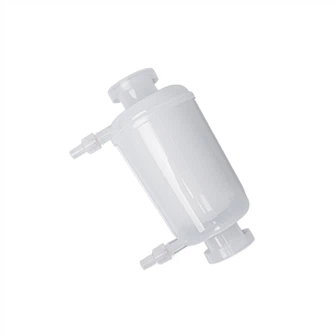
Hollow Fiber Module:
The feed solution flows axially through the lumen of the hollow fibers, while the permeate passes radially through the membrane wall.
Membrane Cassette:
Multiple flat-sheet membranes are stacked together, typically separated by screens or flow spacers that create tangential flow channels to enhance mass transfer.
1. Comparison of Key Performance Parameters
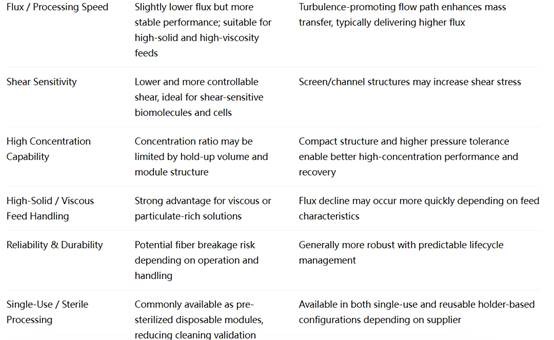
A. Flux / Mass Transfer Efficiency (Processing Speed)
Membrane cassettes generally achieve higher flux and shorter processing times.
The spacer/screen structure creates turbulence at the membrane surface, reducing gel layer formation and improving mass transfer efficiency and overall flux performance.
Hollow fiber modules usually provide slightly lower but more stable flux.
Their open flow channels reduce hydraulic resistance, making them less prone to sudden fouling when processing high-solid or high-viscosity feed streams.
Case Example:
In UF/DF processing of LNP-mRNA, studies have shown that under identical TMP conditions (≤5 psi) and feed parameters, membrane cassettes demonstrated significantly higher flux, while hollow fiber modules offered lower shear but slightly reduced throughput.
B. Shear Force (Impact on Particles, Viruses, and Biomolecules)
Hollow fiber modules are generally considered gentler.
Their open-channel design means shear mainly follows standard tubular flow behavior and can be quantitatively controlled through flow rate and fiber inner diameter, making them suitable for shear-sensitive materials.
Membrane cassettes introduce additional shear due to the spacer structure.
Although this improves mass transfer, it may also increase localized shear stress.
C. Fouling Resistance / Handling High Solids and High Viscosity
Hollow fiber modules show clearer advantages when processing high-solid-content or viscous materials.
The open flow path lowers fluid resistance and helps maintain stable flux under demanding feed conditions.
Membrane cassettes are generally more suitable for low-to-medium solids applications where high throughput and faster processing are priorities.
Their enhanced mass transfer design can deliver strong performance, although very viscous or high-solid systems may experience faster flux decline depending on membrane material, MWCO/pore size, and process conditions.
D. Pressure Drop and Operating Window (TMP & Feed Pressure)
In hollow fiber systems, pressure drop and shear can be controlled through fiber diameter, fiber length, and crossflow rate.
Smaller fiber diameters increase shear, while longer flow paths increase pressure drop.
In practice, hollow fiber TFF systems are commonly designed and scaled up using TMP-based calculations.
E. Concentration Factor, Recovery Rate, and Hold-Up Volume
Membrane cassettes are often more advantageous for high-concentration applications and high concentration factors.
Industry experience suggests that membrane cassettes offer a more compact structure, better pressure resistance, higher concentration capability, and often higher product recovery compared with hollow fiber systems.
Hollow fiber modules may have larger hold-up volumes depending on module design and system configuration, which can be more critical when processing small batches of high-value materials.
F. Reliability and Service Life: Fiber Breakage vs. Maintenance
One potential risk of hollow fiber systems is fiber breakage and structural fragility.
Practical experience has shown that hollow fibers can occasionally break, and certain pore structures (such as finger-like structures) may be more susceptible to damage.
Membrane cassettes also require proper maintenance, but their service life can be quite long with appropriate cleaning and storage procedures.
It is important to avoid drying out the membrane and to regenerate the membrane promptly after fouling.
G. Single-Use, Sterility, and Scale-Up
Single-use hollow fiber modules are increasingly popular because they are typically supplied pre-wetted, gamma sterilized, and ready to use, significantly reducing cleaning validation requirements.
They can also be scaled efficiently from laboratory development to full-scale manufacturing.
Scale-up logic:
Both hollow fiber modules and membrane cassettes can be scaled up by increasing membrane surface area or operating multiple units in parallel. Hollow fiber product documentation also emphasizes that multiple sizes are available, enabling straightforward scale-up from laboratory to production scale.
2. Selection Comparison Table
Dimension Hollow fiber Cassettes