
Peptide Purification Process Development And Scale-Up
Peptide therapeutics, due to their strong targeting ability and high safety profile, have become key treatment options for diseases such as diabetes and cancer. However, the complex impurities generated during synthesis-such as truncated peptides, deletion variants, and oxidized products-pose significant challenges for purification processes. This report systematically outlines methods for establishing peptide purification workflows, strategies for parameter optimization, and techniques for scale-up. By examining three representative cases-GLP-1 analogs, antitumor cyclic peptides, and ultra-long peptides (60 amino acids)-it provides an in-depth analysis of core challenges and solutions in process development, offering comprehensive technical guidance for the industrialization of peptide therapeutics.
1. Methods for Establishing Peptide Purification Processes
1.1 Analysis of Target Peptide Characteristics
Amino acid sequence: Hydrophobicity (for example, in semaglutide, Phe at positions 6 and 23, Leu at positions 14 and 26, Val at positions 10 and 30, Ile at position 24, Ala at positions 18 and 25, Trp at position 27, Tyr at position 13-whose phenyl ring contributes to hydrophobicity-and α-aminoisobutyric acid (Aib) at position 2, which is a non-proteinogenic amino acid with high hydrophobicity). In addition, semaglutide has a 17-carbon fatty diacid side chain attached to the lysine residue at position 26; this highly hydrophobic modification is a key structural feature enabling albumin binding and long-acting properties. Charge distribution (ratio of acidic/basic residues, e.g., the full amino acid sequence of semaglutide is: His-Aib-Glu-Gly-Thr-Phe-Thr-Ser-Asp-Val-Ser-Ser-Tyr-Leu-Glu-Gly-Gln-Ala-Ala-Lys-Glu-Phe-Ile-Ala-Trp-Leu-Val-Arg-Gly-Arg-Gly, in which the ratio of acidic to basic amino acids is 1:1). Furthermore, semaglutide is a single-chain peptide with no disulfide bonds in its structure.
Molecular weight: This affects the selection of chromatography columns and membrane modules (for example, the separation range of SEC and the retention/permeation range of UF/DF membranes). For instance, the chemical structure of semaglutide is C₁₈₇H₂₉₁N₄₅O₅₉, giving a calculated molecular weight of 4113.6 Da. During SEC separation of semaglutide, Seplife G-25 chromatography resin can be chosen, and for concentration and buffer exchange, a 1 kDa membrane module can be used.
Stability: Sensitivity to pH, temperature, and oxidative conditions. For example, semaglutide has a pI of 5.4, and its degradation is relatively high at pH 4.5–5.5, which is near its pI, while it remains relatively stable under other pH buffer conditions.
Case Reference: Semaglutide (31 amino acids) contains Gln residues, which require avoiding deamidation under low pH conditions. The amide group (-CONH₂) on the Gln side chain can undergo hydrolysis under specific conditions (such as acidic or basic environments, or enzyme-catalyzed reactions), converting into negatively charged glutamic acid (Glu) residues (-COOH). This reaction can alter the protein's charge distribution, conformation, and functional properties. Deamidation of glutamine (Gln) groups under low pH (acidic conditions, pH < 5) is a chemical reaction in which the amide group (-CONH₂) of the Gln side chain is hydrolyzed to form the carboxyl group (-COOH) of Glu, releasing ammonia (NH₃) in the process. Therefore, acidic conditions should be avoided during the purification and storage of semaglutide.
1.2 Analysis of Impurity Profile and Control Objectives
Synthetic Impurities: truncated peptides (missing 1–2 amino acids), deletion peptides (sequence errors), and residual protecting groups. Sequence-related impurities are typically removed using reversed-phase chromatography.
Folding Impurities: Most peptides consist of single chains and do not require folding. Folding-related impurities mainly occur in protein preparations, such as disulfide bond mispairing.
Process-Related Impurities: metal catalysts (palladium, nickel) and residual organic solvents.
Control Criteria: Purity ≥ 98% (HPLC), single impurity ≤ 0.5%, metal residues ≤ 10 ppm (ICH Q3D). Product-related impurities of semaglutide include aggregates, degradation products, modification-/conjugation-related impurities, stereoisomers of asymmetric carbons, modified variants (e.g., methionine oxidation, aspartic acid deamidation/isomerization), residual intermediates, and process by-products. For products expressed via yeast fermentation, additional post-translational modifications such as methylation, acetylation, and glycosylation may be present, manifesting macroscopically as molecular size variants, charge variants, and glycoform heterogeneity.
1.3 Selection of Purification Platform Technology
|
Technology |
Applicable Scenarios |
Resolution |
flux |
cost |
|
Reversed-Phase Chromatography(RPC) |
Peptides with significant hydrophobic differences |
high |
medium |
high |
|
Ion Exchange(IEX) |
Charged peptides (e.g., containing Lys, Arg) |
medium |
high |
medium |
|
Gel Filtration(SEC) |
Removal of dimers/degradation fragments |
low |
low |
low |
|
Hydrophobic Interaction Chromatography (HIC) |
Peptides containing aromatic amino acids |
medium |
medium |
high |
2. Process Development Workflow and Key Steps
Crude Material Pretreatment
Selection of Dissolution Buffer: The choice of purification method after dissolving the crude material should guide the selection of the dissolution buffer. Compatibility between the dissolution buffer and the subsequent purification method must be considered to avoid buffer exchange. For example, semaglutide can be dissolved in 0.1% TFA/acetonitrile for RPC, or in 20 mM Tris-HCl, pH 8.0 for IEX.
Sterile Filtration: 0.22 μm filter membrane is used to remove particulates and prevent column clogging. The principles of direct-pressure filtration and TFF (tangential flow filtration) differ. When selecting a membrane filtration unit, factors such as membrane flux, retention range, material, and system dead volume should be considered. For sterile filtration, a 0.22 μm direct-pressure filter is typically chosen, whereas for clarification, 0.1–0.22 μm TFF membranes or a series of membranes with different pore sizes are often used in stepwise filtration. Alternatively, a combination of membranes with multiple pore sizes, such as depth filters, can also be employed.
Chromatography Column Screening
Resin/Stationary Phase Types: Silica C18 (high loading capacity), Silica C8 (rapid separation), polymer-based matrices (alkali-resistant, e.g., polystyrene microsphere reversed-phase resins).
2.1 Ion Exchange Chromatography (IEX)
Column Dimensions: Laboratory scale (4.6 × 250 mm), production scale (50 × 500 mm).
Gradient Optimization:
Acetonitrile Gradient Range: Set according to peptide retention time (e.g., 20%–50%).
Gradient Slope: A shallow slope (0.5%/min) improves resolution, whereas a steep slope (2%/min) shortens the run time.
Basis for Selection of Purification Methods and Comparative Analysis
3.1 Key Advantages of Reversed-Phase Chromatography (RP-HPLC)
High Resolution: Capable of separating impurities with molecular weight differences as small as 1 Da (e.g., deamidation products).
Broad Applicability: Suitable for over 80% of synthetic peptides.
3.2 Specific Applications of Ion Exchange (IEX)
Charge-Dependent Separation: Peptides with different charge properties are separated using a pH gradient elution (e.g., pH 4.0 → 7.0).
3.3 Multidimensional Chromatography
RP-IEX Combination: Peptides are first purified by IEX to remove charged impurities, followed by RP-HPLC for final polishing. This is currently the most widely used and mainstream approach for peptide purification, commonly applied to peptides such as insulin and GLP-1R analogs.
4. Process Condition Optimization Strategies
4.1 Mobile Phase Composition Optimization
Additive Selection:
0.1% TFA: Improves peak shape and suppresses silanol interactions.
10 mM NH₄HCO₃: Can be used as a TFA alternative to reduce interference in mass spectrometry detection.
Gradient Design:
Stepwise Gradient: Using 20%–30% (10 min) → 30%–40% (40 min) can improve yield.
4.3 Detection Condition Settings
UV Detection Wavelengths: 214 nm (peptide bond absorption), 280 nm (Trp/Tyr).
5. Scale-Up from Laboratory to Production
5.1 Linear Scale-Up
After successfully developing a small-scale laboratory purification process, the process is proportionally scaled up in a non-production environment (e.g., pilot plant). The goal is to verify the feasibility, stability, and reproducibility of the process, laying the foundation for subsequent commercial production. The core of this process is to address new challenges arising from scale-up, such as equipment compatibility, changes in operating conditions (e.g., temperature, pressure, flow rate), differences in mass transfer efficiency, and batch-to-batch consistency control.
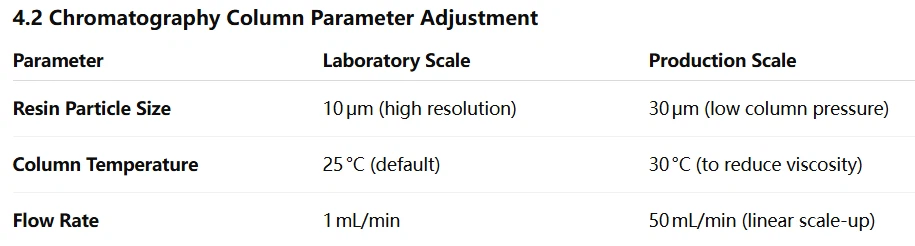
Column Diameter Scale-Up: Scale according to the cross-sectional area (e.g., 4.6 mm → 50 mm, scale factor ≈ 118×).
Flow Rate Adjustment: Maintain linear flow rate (e.g., 1 mL/min → 50 mL/min).
Gradient Extension: Extend gradient time proportionally to column volume (e.g., 60 min → 300 min)
5.2 Production-Scale Equipment Selection
Dynamic Axial Compression Columns (DAC): Suitable for reversed-phase resins, polystyrene small-particle (10–15 µm) ion exchange resins, and polymer-based hydrophobic resins. In contrast, low-pressure glass chromatography columns are more suitable for agarose bead resins and are widely used in the recombinant peptide capture stage.
Conclusion
Peptide purification processes should focus on the target molecule's characteristics, achieving efficient separation through multidimensional chromatography, intelligent parameter optimization, and innovative equipment. Three major case studies demonstrate that scaling up from development to production requires balancing scientific rigor with engineering considerations. Future technologies are expected to evolve toward continuous, intelligent, and green processes.