
Downstream Purification Process For The Feline Trivalent Vaccine — Ultrafiltration
Feline viral rhinotracheitis, feline calicivirus disease, and feline panleukopenia (feline distemper) are the three major infectious diseases threatening the health of domestic cats in China. Feline viral rhinotracheitis is caused by a herpesvirus and is highly contagious. The morbidity rate in kittens can reach 100%, with a mortality rate of 20%–50%. Feline calicivirus infection is mainly characterized by oral ulcers and respiratory symptoms. Although its mortality rate is relatively low, it can easily lead to chronic inflammation and joint lesions. Feline panleukopenia is characterized by acute gastroenteritis and a sharp decline in white blood cell counts; the mortality rate in kittens exceeds 50%. Therefore, the development of a trivalent inactivated vaccine can provide better protection for cat populations.
Feline viral rhinotracheitis virus, also known as feline herpesvirus type 1 (FHV-1), belongs to the subfamily Alphaherpesvirinae of the family Herpesviridae and exhibits the typical morphological characteristics of herpesviruses. The FHV-1 genome is linear double-stranded DNA, approximately 134 kb in length, and the virions are approximately 150–160 nm in diameter.
Feline calicivirus (FCV) belongs to the genus Vesivirus in the family Caliciviridae. It is an important pathogen of felids and mainly causes upper respiratory tract disease, oral ulcers, and systemic infection. The FCV genome is positive-sense single-stranded RNA, approximately 7.5–7.7 kb in length, and the virions are approximately 35–40 nm in diameter.
Feline panleukopenia virus (FPV) belongs to the genus Protoparvovirus in the family Parvoviridae and has the typical structural characteristics of parvoviruses. Its genome is linear single-stranded DNA, approximately 5.1 kb in length. The viral particles have an icosahedral structure and are approximately 20–24 nm in diameter.
The following are application examples of Jiuling Technology's ultrafiltration hollow fibers in feline trivalent vaccine production.
Feline Viral Rhinotracheitis Virus (FHV-1)
We used a 260 cm² hollow fiber with a 300 kDa MWCO (HES030010030) to concentrate and diafilter 300 mL of clarified feline viral rhinotracheitis virus harvest. Throughout the ultrafiltration process, we evaluated virus recovery, total protein removal, membrane flux decline, and water flux recovery.
|
Sample |
Volume (mL) |
log₁₀ (TCID₅₀/mL) |
Virus Recovery (%) |
Total Protein Concentration (μg/mL) |
Total Protein Amount (μg) |
Total Protein Removal (%) |
|
Feed |
300 |
7.81 |
95.47 |
1604.8 |
481440 |
97 |
|
Concentrate |
30 |
8.72 |
348.4 |
10452 |
||
|
Retentate Rinse |
50 |
7.74 |
79.1 |
3955 |
At a shear rate of 2,000 s⁻¹, 300 mL of feed was concentrated and diafiltered to 30 mL, representing 10-fold concentration. A 20-fold diafiltration was performed (two buffer additions), followed by one rinse with an additional 50 mL of liquid. Virus recovery was 95.47%, and total protein removal was 97%. For industrial-scale production, the number of retentate rinses should be increased as much as possible based on the dead volume of the tubing. In general, three rinses are sufficient for complete recovery.

The period from 0 to 25 min was the concentration step, and the period from 25 to 70 min was the diafiltration step. Throughout the ultrafiltration process, TMP was ≤3 psi, with the feed rate kept constant. The average process flux was 28.7 LMH.
|
TMP (bar) |
LMH |
Water Flux Recovery (%) |
|
|
Before Use |
1.0 |
300 |
96.7 |
|
After Cleaning |
1.0 |
290 |
We measured the water flux of the hollow fiber before and after use. Under the same feed rate, feed pressure, and retentate pressure, the hollow fiber achieved a water flux recovery of 96.7%.
Feline Calicivirus (FCV)
We used a 260 cm² hollow fiber with a 100 kDa MWCO (HES010010030) to concentrate and diafilter 300 mL of clarified feline calicivirus harvest. Throughout the ultrafiltration process, we evaluated virus recovery, total protein removal, membrane flux decline, and water flux recovery.
|
Sample |
Volume (mL) |
log₁₀ (TCID₅₀/mL) |
Virus Recovery (%) |
Total Protein Concentration (μg/mL) |
Total Protein Amount (μg) |
Total Protein Removal (%) |
|
Feed |
300 |
8.9 |
95.6 |
2030.2 |
609060 |
94.8 |
|
Concentrate |
37.5 |
9.71 |
506.8 |
19005 |
||
|
Retentate Rinse |
50 |
8.85 |
253.3 |
12665 |
At a shear rate of 2,000 s⁻¹, 300 mL of feed was concentrated and diafiltered to 37.5 mL, representing 8-fold concentration. A 20-fold diafiltration was performed (two buffer additions), followed by one rinse with an additional 50 mL of liquid. Virus recovery was 95.6%, and total protein removal was 94.8%. For industrial-scale production, the number of retentate rinses should be increased as much as possible based on the dead volume of the tubing. In general, three rinses are sufficient for complete recovery.
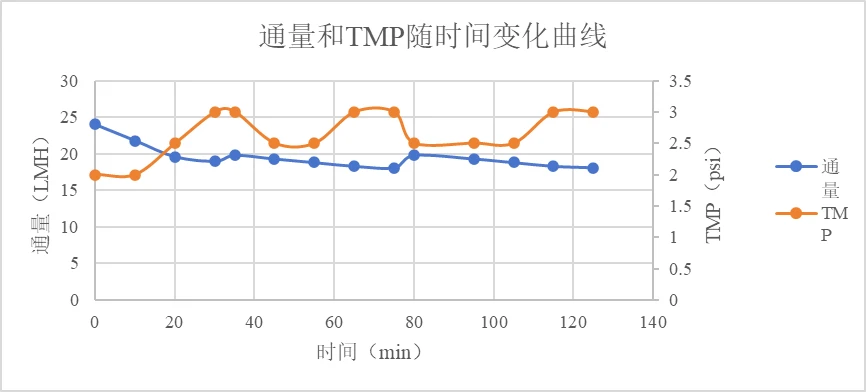
The period from 0 to 35 min was the concentration step, and the period from 35 to 125 min was the diafiltration step. Throughout the ultrafiltration process, TMP was ≤3 psi, with the feed rate kept constant. The average process flux was 18.7 LMH.
|
TMP (bar) |
LMH |
Water Flux Recovery (%) |
|
|
Before Use |
1.0 |
200 |
95 |
|
After Cleaning |
1.0 |
190 |
We measured the water flux of the hollow fiber before and after use. Under the same feed rate, feed pressure, and retentate pressure, the hollow fiber achieved a water flux recovery of 95%.
Feline Panleukopenia Virus (FPV)
We used a 260 cm² hollow fiber with a 100 kDa MWCO (HES010010030) to concentrate and diafilter 300 mL of clarified feline panleukopenia virus harvest. Throughout the ultrafiltration process, we evaluated virus recovery, total protein removal, membrane flux decline, and water flux recovery.
|
Sample |
Volume (mL) |
log₁₀ (TCID₅₀/mL) |
Virus Recovery (%) |
Total Protein Concentration (μg/mL) |
Total Protein Amount (μg) |
Total Protein Removal (%) |
|
Feed |
300 |
6.35 |
94.9 |
2127 |
638100 |
95.8 |
|
Concentrate |
37.5 |
7.17 |
428.8 |
16080 |
||
|
Retentate Rinse |
50 |
6.22 |
210 |
10500 |
At a shear rate of 2,000 s⁻¹, 300 mL of feed was concentrated and diafiltered to 37.5 mL, representing 8-fold concentration. A 20-fold diafiltration was performed (two buffer additions), followed by one rinse with an additional 50 mL of liquid. Virus recovery was 94.9%, and total protein removal was 95.8%. For industrial-scale production, the number of retentate rinses should be increased as much as possible based on the dead volume of the tubing. In general, three rinses are sufficient for complete recovery.

The period from 0 to 30 min was the concentration step, and the period from 30 to 110 min was the diafiltration step. Throughout the ultrafiltration process, TMP was ≤3 psi, with the feed rate kept constant. The average process flux was 21.2 LMH.
|
TMP (bar) |
LMH |
Water Flux Recovery (%) |
|
|
Before Use |
1.0 |
190 |
96.3 |
|
After Cleaning |
1.0 |
183 |
We measured the water flux of the hollow fiber before and after use. Under the same feed rate, feed pressure, and retentate pressure, the hollow fiber achieved a water flux recovery of 96.3%.
The results show that Jiuling Technology's 300/100 kDa hollow fibers can operate stably and are suitable for this application. Virus recovery and protein removal rates achieved with the 300/100 kDa hollow fibers vary depending on the feed material. In general, virus recovery can reach approximately 95%, while protein removal is typically 95%–97%.
Jiuling Technology welcomes inquiries for test units and related evaluations.
About Jiuling
Jiuling Technology specializes in the development and manufacture of products for biopharmaceutical applications, cell culture, purification, and separation. Its products are used in filtration, testing, clarification, purification, and concentration processes in biopharmaceuticals, diagnostics, and industrial fluids. The product portfolio includes ultrafiltration centrifugal devices, ultrafiltration/microfiltration membrane cassettes, virus removal filters, sterilizing-grade filters, tangential flow filtration systems, depth filter modules, and hollow fibers, serving applications such as biopharmaceutical manufacturing and cell culture. Our membranes and membrane filters are widely used for concentration, extraction, and separation in prefiltration, microfiltration, ultrafiltration, and nanofiltration. We operate multiple product lines, ranging from small-scale single-use laboratory filtration to production-scale filtration systems, sterility testing, fermentation, and cell culture, meeting a wide range of process development and manufacturing needs. Jiuling Technology looks forward to working with you.