
Problems and Countermeasures in the Application of Sterilization Filtration Technology in Drug Production
Problems and Countermeasures in the Application of Sterilization Filtration Technology in Drug Production
1. Introduction
Sterilization is a functional definition. Sterilization filtration is the process of removing microorganisms in liquid or gas by physical retention to meet the requirements of sterile pharmaceuticals. Sterilization filters refer to filters that are challenged with Brevundimonas diminuta with a challenge level greater than or equal to 1×10⁷cfu/cm2 filtration area concentration. After proper verification, they can stably produces sterile filtrate.
2. Problems in Sterilization Filtration
In the production process of aseptic drugs, especially for non-terminal sterilized products, it mainly relies on sterilization filtration and sterile production process to meet the requirements of sterile control. With the wide application of sterilization filtration technology in the pharmaceutical industry, the risk of sterilization filtration has also attracted the attention of the industry. In order to strengthen the supervision of drug production, standardize the scientific and systematic development of sterilization filtration technology and application by drug manufacturers, and ensure the safety, effectiveness and quality stability of sterile drugs, the State Drug Administration formulated Guidelines for Sterilization and Filtration Technology and Application. According to the content of Guidelines for Sterilization and Filtration Technology and Application and combined with the defective items of sterilization filtration in the inspection of sterile drugs, the problems in sterilization filtration technology and application can be divided into four points: filtration process and system design, verification of sterilization filtration, use of sterilization filter and system, documentation and records.
3. Countermeasures
(1) Pay attention to the use and standardize the operation and record
The use, integrity testing and recording of the sterilization filter have the highest proportion of problems in the application of the sterilization filtration technology. Most of these problems are caused by irregular operation or incomplete records. This reminds enterprises to pay attention to the use and standardize the operation and record.
(2) Focus on filtration process design and reasonably determine process parameters
The main problems in the design of filtration process are that the parameters of some filtration processes are not determined and the management of suppliers is not perfect. When enterprises choose filters, they often only consider the material, specification and model of the filter. About process parameters such as filtration pressure range, temperature range, filtration flow rate, and sterilization conditions they just refer to the filter manual. In fact, the enterprise should determine the filtration process parameters according to the properties of the medium to be filtered and the process requirements, and confirm the range of process parameters.
(3) Fully carry out evaluation and verification and standardize the number of repeated usage
The design and manufacture of liquid sterilization filters are generally considered for single use, but in actual production, there are often cases of repeated usage. Enterprises should evaluate and verify the reuse of filters on the basis of a full understanding of product and process risks, and clearly stipulate the maximum number and time of reuse in production.
(4)Assess the risk of the filtration process and carry out the verification of sterilization filtration
Filtration process validation generally includes bacterial retention tests, chemical compatibility tests, extractable or leaching tests, safety assessments and adsorption assessments. If the product is used as the wetting medium for the integrity test after filtration, relevant product integrity test verification should also be carried out.
Conclusion
Sterilization filtration technology plays a very important role in the sterility assurance of sterile drugs, especially non-terminal sterilized drugs. Correct application of sterilizing filtration technology can make the filtrate meet the requirements of sterility, but sterilization filtration cannot be used as the only means to ensure product sterility. The sterile production process should be adopted in the production process of back-end of sterilization filtration to control microbial contamination so as to ensure the final sterility of the product.
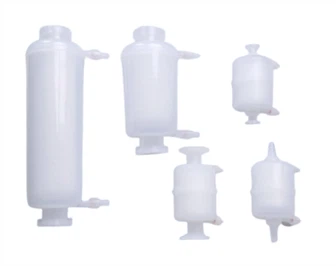
Guidling sterilization filters have reliable bacterial retention capacity, high flow rate and high interception efficiency and good chemical compatibility with a variety of connectors. They also have superior handling capabilities for clogging materials (culture medium solutions, etc.) and are 100% integrity tested.