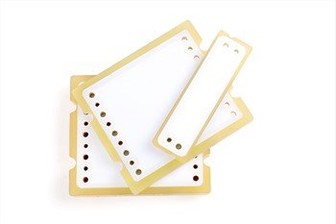

FAQs about Microfiltration&Ultrafiltration Cassettes
FAQs about Microfiltration&Ultrafiltration Cassettes


Q1. How to choose the appropriate transmembrane pressure?
A: Transmembrane pressure is related to feed rate, feed liquid viscosity, membrane pore size, and diaphragm valve adjustment. Generally, the transmembrane pressure is controlled at 1-2 bar; small 0.11 square meter membrane packs are used in a single piece and are generally used for research and development. The transmembrane pressure is generally adjusted from small to high, and the range is controlled between 0-2bar. If it is the first time to do tangential flow, you can set the feed pressure to 1 bar and the return pressure to about 0.5 bar for testing.
Q2. How to choose the flow rate of peristaltic pump?
A: The flow rate of the general pump is set according to the membrane area. The recommended feed rate per square meter of membrane area for ultrafiltration cassettes is 200-400L/h; the recommended feed rate per square meter of membrane area for microfiltration cassettes is 400-600L/h; in addition, the smaller the membrane pore size, the lower the feed rate generally, because the transmembrane pressure will increase at high flow rates.
Q3. How should the cassette be cleaned and what are the cleaning criteria?
A: For ultrafiltration and microfiltration cassettes, after washing with water, wash with 0.5M NaOH for 30 minutes, and then enter the lye with the diaphragm valve fully open. After the reflux pH rises, the return pipe is put back into the lye cup. The diaphragm valve rotates so that the reflux pressure gauge reach about 0.2bar. The three tubes were washed in a container for 30 minutes; then they were preserved with 0.1M NaOH. After cleaning the 1kd and 3kd ultrafiltration membrane with lye, it must be washed with water to neutral and then stored in 1.5% sodium bisulfite.
Cleaning standard: The membrane flux is restored to more than 90% of the initial membrane flux.
Q4. How to conduct water flux test?
A: To select a feed rate, adjust the transmembrane pressure of the diaphragm valve to 1.5bar and test the LMH value of water in the permeate end. After the membrane cassette is used up each time, if you need to observe the life of the membrane pack or whether it is cleaned, you can keep the same feed rate and transmembrane pressure as above for testing.
Q5. How to choose the membrane pore size?
A: For ultrafiltration concentration: you can choose a membrane pore size that is 3-5 times smaller than the target protein. For example, if the target protein is 150kd, you can choose a 30kd or 50kd membrane cassette. For clarification and filtration: supernatant after crushing yeast, CHO cell culture medium, etc., generally choose 0.22 or 0.45μm membrane cassette.
Q6. How to choose the membrane area?
A: According to the sample processing volume and the customer’s expected processing time to choose appropriate membrane area. Generally, the recommended treatment volume of 0.11m2 membrane cassette is 0.5-4L, the recommended treatment volume of 0.5m2 membrane cassette is 4-20L, and the recommended treatment volume of 1.3m2 membrane cassette is 20-100L. For example, the sample volume of the customer is 150L, and the molecular weight of the target protein is 30kd. It is expected to complete the concentration of 150L sample to 10L within 2 hours. The LMH obtained by using a 5kd membrane cassette in a small amount of testing is 20. The membrane area can be calculated according to the treatment capacity and LMH. 140L/20LMH/2h=3.5m2.
Q7. What is the lifespan and usage times of the ultrafiltration membrane cassette?
A : The service life of the membrane bag is very long. Under the premise of normal use and maintenance, the lifespan and usage times of membrane cassette can be longer than the packing. Complete regeneration, avoid contact with some unknown high-concentration organic reagents and keep them reasonably.
Q8. What is the difference between tangential flow velocity and membrane flux?
A: Membrane flux refers to the membrane permeation flux. An increase in the tangential flow rate will facilitate the scouring of macromolecules on the membrane surface, and the permeation rate of small molecules will increase. Generally, the greater the tangential flow rate, the greater the membrane flux.
Q9. Can an integrity tester be used to test multiple membrane cassettes?
A: Integrity tester will have a certain limit, the integrity tester generally has a limit of about 1000mL/min, if the measured value of the membrane cassette is greater than this limit, the integrity tester is not suitable for testing. It is recommended that you use barometer with a larger flow rate to detect.
Q10. When installing the membrane cassette, it is mentioned that “check whether the torque is in place”, how to check the torque specifically?
A: When installing, first of all, if the torque is reached, there will be a feedback, and the torque wrench will remind you that it has arrived. If there is a change in temperature, such as thermal expansion and contraction, it is recommended that you increase the torque appropriately when it is cold, and adjust it again. If the solution is hot, it is recommended to loosen the clamp before adding the solution to prevent the membrane cassette from being affected by thermal expansion.
Q11. During ultrafiltration, when the solution is insufficient, should close the permeate end, cycle for waiting or stop for waiting?
A: If the solution is insufficient, you must close the permeate end and cycle for waiting . It is not recommended to stop for waiting, because if your solution stops on the surface of the membrane cassette, it may undergo some property changes and affect filtration effect. It is generally recommended to flush out the material in time and discharge the material with the head air.
Q12. Will there be any impact on stopping the pump during concentration or diafiltration?
A: When the pump is stopped, there will be a certain property change on the surface of the membrane, which will affect the process effect of your subsequent permeation.
Q13. Is the gasket of the membrane cassette disposable or reusable? Is there any cleaning requirement?
A: The gasket of the membrane cassette can be reused, but it is recommended to replace it every six months when it is reused, because the gasket may be deformed or aged during use.
Q14. The concentration flow rate of the membrane cassette is obviously slowed down. Do you have any good cleaning suggestions?
A: During the ultrafiltration concentration process of membrane cassette, the flow rate at the permeation end will gradually decrease. Because of the formation of filter cake layer, the flux will be somewhat exhausted. Therefore, when developing, the processing capacity per unit volume of solution is considered. On the premise that the permeation end satisfies the process efficiency, select the appropriate membrane area to avoid the situation of too slow speed. Generally, by increasing the membrane area, the process requirements can be effectively met.
Q15. How to judge that the service life of the membrane cassette has expired and cannot be used again?
A: This judgment is firstly based on the validity period of the membrane cassette itself, followed by the recovery of the water flux of the membrane cassette, which is a condition for monitoring whether the performance of the membrane cassette is restored. There will be an explanation verification when doing the membrane cassette process. Sometimes there will be a water flux. If the quality of the membrane cassette and other indicators are not affected, it can be used as the service life of the membrane cassette. This requires us to explore according to the specific process. Generally, after 100 times of use or about 2 years, the flux level will be verified to determine whether it needs to be replaced.
Q16. How to identify the cleaning effect? How to identify the degree of cleaning qualified?
A: The cleaning effect needs to test the TOC, endotoxin, microbial limit, product residue, PH conductivity, etc. after washing with water. This involves cleaning verification, and the final cleaning plan needs to be confirmed after passing these tests.