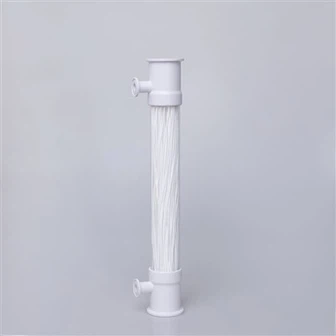

Introduction to the principle of hollow fiber components
1. Background
Hollow fiber components are a new type of fiber material, which consists of a hollow structure of multiple layers of cellulose or minerals. This material has the characteristics of low density, high specific surface area, and high porosity, so it is widely used in filtration, separation, and adsorption.
In the past few decades, hollow fiber components have been widely used in many fields such as biomedicine, food and beverage, environmental protection, and chemical industry. For example, in the field of biomedicine, hollow fiber components are used to prepare biopharmaceutical products and bioreactors. In the field of environmental protection, hollow fiber components are used for water treatment, wastewater treatment, and air purification.
The background of hollow fiber components is very rich. It has not only been widely verified in applications, but also has a deep research foundation in the fields of materials science and fiber technology. Due to its unique structure and performance, hollow fiber components have high potential and will continue to play an important role in the future.

2. Principle
Definition of membrane separation technology:
Filter membrane: a thin film material made of porous polymers with one or more layers;
Membrane separation technology: a separation technology that uses external conditions such as pressure difference or concentration difference as a driving force to allow only certain specific substances in multiple components to pass through, while other substances are intercepted; usually used in the separation, purification, and concentration of mixtures.
Filtration method:
Direct current filtration: also known as dead-end filtration, the feed liquid flows perpendicular to the surface of the filter membrane, all liquids pass through the filter medium, and pollutants are retained inside or on the surface of the filter membrane.
For example: clarification filtration, prefiltration, sterilization filtration, virus removal filtration, vacuum filter, mainly concentrated in the category of microfiltration.
Tangential flow filtration: also known as cross-flow filtration, the feed liquid flows parallel to the surface of the filter membrane, part of the liquid passes through the filter medium, and pollutants are retained on the surface of the filter membrane or reflux from the other end of the membrane.
For example: membrane package, hollow fiber ultrafiltration, mainly concentrated in the category of ultrafiltration.
Features of TFF filtration:
The working principle of tangential flow filtration (TFF) is that the solution flows in a direction parallel to the membrane. Under the pressure, molecules smaller than the membrane pores pass through the membrane and become permeate, while molecules larger than the membrane pores are retained and become concentrate.
Concepts related to hollow fibers:
Transmembrane pressure difference (TMP): The average pressure difference on both sides of the membrane is the driving force for the liquid to pass through the membrane. Transmembrane pressure difference = (Pin + Preturn) / 2-Ppermeate
Flux: The amount of fluid that passes through the membrane per unit membrane area per unit time. LMH, L/(m2.h)
Normalized water flux (NWP: Normalized Water Permeability): The flux of water at unit pressure and standard temperature. L/(m2.h.psi)
Molecular weight cutoff (MWCO): Characterizes the pore size of the ultrafiltration membrane.
Minimum working volume: The minimum working volume of the tangential flow filtration system refers to the circulating liquid volume required to operate the system under specific tangential flow flow conditions. The minimum working volume depends on the retention volume and circulation flow rate of the system and components. In high-concentration applications, such as virus concentration, the minimum working volume is an important consideration, and the target reflux concentration volume must be higher than the minimum working volume of the system.
Shear rate: The rate of change of the flow velocity of the fluid relative to the radius of the circular flow channel. Unlike the membrane package, in hollow fiber experiments, the shear rate is usually used instead of the tangential flow rate to characterize the circulation flow parallel to the membrane.
Concentration polarization: During the ultrafiltration process, the solutes that cannot pass through the membrane accumulate on the membrane surface under pressure to form a gel layer. The concentration in the area near the membrane interface is getting higher and higher. Under the action of the concentration gradient, the diffusion of the solute from the membrane surface to the solution increases, which increases the fluid resistance and local osmotic pressure, resulting in a decrease in flux.
Gel layer: It is the main factor in the resistance of ultrafiltration membranes.
Factors to consider when selecting hollow fiber membranes:
1. Choice of membrane form: For samples that are clarified, rich in particles, have high viscosity, and require low shear force concentration, such as large particle virus molecules with low stability, hollow fiber membranes are usually selected for clarification/concentration and diafiltration;
2. Choice of fiber diameter: 0.5mm inner diameter is preferred for sample concentration/diafiltration; 1.0mm inner diameter is preferred for sample clarification;
3. Choice of filtration accuracy: The pore size of the hollow fiber membrane will affect its filtration accuracy. The appropriate pore size should be selected according to the requirements of the specific application to ensure effective filtration of the target substance. The following are several common application options:
① Concentration/diafiltration: In order to effectively intercept the target molecule and ensure the yield, a membrane pore size of 1/3-1/5 of the target sample molecule is generally recommended. At the same time, in order to minimize the content of impurities during the concentration and diafiltration process, the pore size should be as large as possible under the condition that the target molecule yield is guaranteed;
② Clarification: It is recommended to select a membrane pore size that is 5-10 times larger than the target molecule to ensure the target molecule yield as much as possible, especially if the sample is very "dirty", a membrane pore size of more than 10 times should be selected;
③ Molecular separation: If you want to use a tangential flow filtration membrane to separate two target molecules of different sizes, the molecular weight of the target molecule should be at least 10 times different, and the diafiltration should be sufficient;
④ Cell collection: If the target protein is expressed in an E. coli bag, the first step to collect the bacteria is to use an ultrafiltration membrane of 500K/750K.
4. Effective length: The process amplification feature of hollow fibers is that as long as the effective length is kept consistent, direct process amplification can be performed. However, components of different lengths cannot be linearly amplified because of the significant difference in pressure drop at both ends, and the internal pressure and flow rate distribution of the flow channel also change accordingly. Usually, components with shorter flow channel lengths tend to be selected when treating materials with high viscosity and high fouling.
Application of hollow fiber components
Application areas:
Purification, concentration and dialysis of vaccines
Purification, concentration and dialysis of viral vectors
Clarification and filtration of cells and bacteria in fermentation broth
Recovery and washing of cells and bacteria
Concentration and dialysis of proteins
Product features:
Lower flux than membrane packages
Gentle to materials
Simple and open flow channel
Easy to assemble
Easy to empty
MWCO selection:
It is necessary to consider the separation selectivity of the membrane and the risk of blockage during the treatment process. Therefore, under the premise of ensuring selectivity and flux, membranes with relatively small pores should be selected as much as possible to reduce the slow entry of impurity particles into the membrane pores and extend the service life. Common processing scenarios are as follows:
Virus concentration, purification, removal: 100kD, 300kD, 500kD, 750kD
Recombinant protein/antibody clarification: 500kD, 750kD
Bacteria concentration: 500kD, 750kD